Japan 2026: Foliage Season to Winter Illuminations
September opens cheap and quiet, November peaks with foliage crowds and higher prices, and the first three weeks of December are the best-value window of the entire back half of the year. That’s the shape of Japan’s autumn-into-winter travel season, and it’s worth planning around rather than picking dates at random.
Verified: August 23, 2026.
The four-month shape, month by month
September is Japan’s most underrated month. Summer heat is breaking by the back half, typhoon season is a real risk through mid-month (check forecasts before booking non-refundable Okinawa or coastal legs), but hotel prices citywide sit near their yearly low and Tokyo and Osaka both run soft. Foliage hasn’t started, so this is a month for cities, onsen towns, and theme parks without the November crush.
October is the transition month. Hokkaido’s mountains (Daisetsuzan, around Asahidake) turn first, usually the last week of September into early October, and the color moves south and downhill through the month. Weather stabilizes, humidity drops, and this is arguably the best walking-around month in the country, before the foliage crowds arrive in the cities.
November is peak foliage and peak demand at once. Kyoto and Tokyo typically color mid-to-late November, sometimes holding into the first week of December in sheltered spots like Kyoto’s Eikando or Tokyo’s Rikugien. This is also the most expensive and most crowded month of the entire September-December window, hotel rates in Kyoto climb 30-60% above October baseline for the last two weeks, and famous temples run at visible capacity by mid-morning.
December splits into two different trips. The first three weeks (through roughly December 27) are quiet and cheap, foliage tourists have gone home, ski season hasn’t started in earnest, and cities run their winter illuminations without the crowds those same lights pull in late December. The final week, December 28 through New Year, flips hard: domestic travel spikes for the holidays, Tokyo and Osaka hotel rates jump 40-80%, and ski towns like Niseko and Hakuba fill with both domestic and international visitors chasing early powder.
What it costs to move through this window
A baseline Tokyo or Osaka hostel-and-konbini day still runs close to ¥8,090 ($50) in September and the first half of October, before foliage demand touches city hotel pricing at all. That same day’s accommodation line climbs first, food and transit barely move. Budget an extra ¥3,000-5,000 ($20-33) a night for hotels specifically in the November 15-30 window in Kyoto, less in Tokyo where supply is deeper.
Rail is the other lever. The nationwide JR Pass math still doesn’t favor most itineraries since the 2023 price hike, do the regional pass comparison for your specific route rather than defaulting to it, this holds true regardless of season. What does change seasonally is Shinkansen reserved-seat availability: the Tokyo-Kyoto and Tokyo-Hakone corridors get genuinely tight for the last two weekends of November, book reserved seats as soon as your dates are fixed rather than assuming a same-week booking will work like it does in September.
Events worth building a trip around
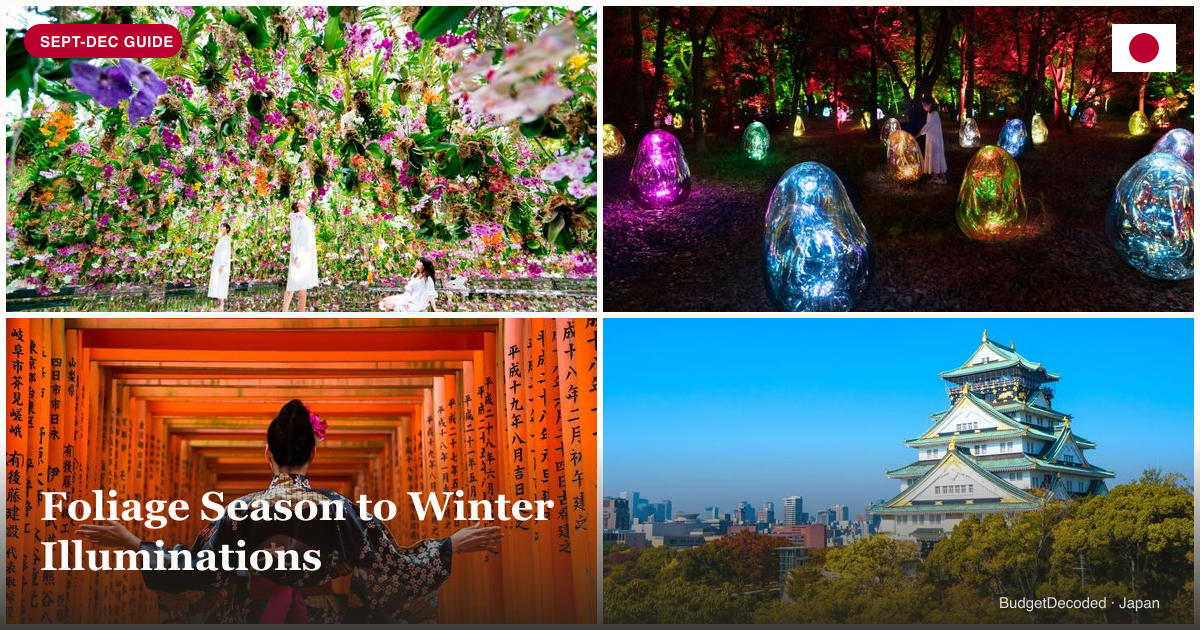
Regional illumination season starts in November and runs through February in most cities, Tokyo’s Marunouchi, Roppongi, and Shibuya displays, Osaka’s Midosuji Illumination, and Kobe’s Luminarie are the headline versions, free to walk through and genuinely worth an evening. Ghibli Park near Nagoya runs seasonal decor through this window too, book timed tickets well ahead regardless of month, they sell out year-round.
Sumo’s Kyushu tournament runs mid-November in Fukuoka, a genuinely different Japan experience if Fukuoka is anywhere near the route, tickets go on sale roughly a month ahead and the cheap seats move fast. If skiing is part of a December plan, Hokkaido and the Nagano resorts open lifts in late November to early December depending on snowfall, but the reliable powder months are properly January-February, an early-December ski trip is a gamble on conditions, not a sure thing.
What’s bookable right now
Four activities worth locking in for this exact window, verified Klook listings rather than guesses: teamLab Planets TOKYO (¥3,590 ($22.19)) pairs the illumination theme with an indoor rain-proof plan for a wet September evening, and its Osaka sibling, teamLab Botanical Garden Osaka (¥1,908 ($11.79)), turns the city’s botanical garden into a night-light installation, both work regardless of foliage timing. For the foliage window itself, the Kyoto Nijo, Bamboo Grove, Golden Pavilion & Fushimi Inari bus tour (¥8,009 ($49.50)) hits four of the city’s best November color spots in one booked seat, no separate train or bus transfers to plan. Osaka Castle (¥299 ($1.85)) rounds it out as the cheapest genuinely worthwhile stop in this list, its moat and grounds turn color in November same as Kyoto’s temples, at a fraction of the crowd.
Cross-reference these against our full Kyoto bus tours comparison and Osaka’s ranked Klook activities before booking, both go deeper on alternatives at each price point than a four-activity shortlist can.
Book now, book later: the actual timeline
Book now if your trip lands November 10-30 or December 28-January 3. These are the two genuine scarcity windows in this stretch. Kyoto ryokans and famous-view hotels for peak foliage dates go 3-4 months out; New Year hotel inventory in Tokyo and Osaka moves almost as early. Reserved Shinkansen seats for those same dates should be booked the moment the one-month advance window opens.
Book 4-6 weeks out for September, October, and the first three weeks of December. These months have real flexibility. Hotel rates barely move week to week, and Shinkansen seats are rarely a genuine bottleneck outside the foliage peak. This is also where last-minute activity bookings still work, Klook and GetYourGuide inventory for Tokyo and Osaka day tours doesn’t sell out the way November weekend slots do. The hotel picker tool is worth running for any of these dates before assuming a neighborhood is sold out.
Sort eSIM versus pocket WiFi early, and run the regional JR Pass comparison once dates are fixed, the math changes with how many long-haul legs the route needs.
Who should go when
Budget-first travelers: September or the first three weeks of December. Same country, same food, same transit system, noticeably lower hotel line and thinner crowds at every sight that matters.
Foliage-first travelers: the back half of November, accept the higher prices and book lodging early, this is the one window where the color genuinely justifies the premium, especially in Kyoto’s temple gardens.
First-timers with fixed dates landing in peak foliage: book Shinkansen and Kyoto lodging the moment dates lock, and lean on Tokyo as a lower-pressure base if Kyoto inventory dries up, the bullet train makes a Tokyo day trip workable even during the crush.
Packing for four different weather patterns in one trip
A September-to-December Japan trip that spans more than one of these months means packing for genuinely different weather, not just “autumn.” September still runs warm and humid in Tokyo and Osaka, light layers and rain gear for typhoon risk. By late October the mornings and evenings turn cold enough for a real jacket even in the cities, and November adds wind on top of that, especially around Kyoto’s river valleys and any Hokkaido leg. December’s first three weeks are properly cold in Tokyo and Osaka and genuinely wintry in Tohoku and Hokkaido, pack for freezing mornings if the itinerary goes north. Layering beats one heavy coat for the whole trip, temperature swings 15-20°F between a Tokyo afternoon and a Hakone or Nikko morning even within the same week.
The honest verdict
September is the best-kept secret in this four-month stretch, cheap, quiet, and still full-color Japan without the foliage math. October is the best all-around month if the schedule allows it. November is worth the premium exactly once if foliage is the actual goal, book it like a peak-season trip because it is one. December’s first three weeks are a genuine bargain hiding in plain sight between two expensive seasons, and the final week is the one stretch on this entire calendar worth avoiding unless a Japanese New Year is specifically the point of the trip.
For the deeper dive on any single piece of this window, the autumn foliage guide, winter budget breakdown, and Kyoto foliage timing each go further than a four-month overview can.
Prices verified as of August 23, 2026.
Book these while you’re there
From Kyoto: Nara, Osaka & Kobe Day Trip – 3 Cities in 1 Day
Gion Corner: Traditional Arts Performance

Private Tea Ceremony and Sake Tasting in Kyoto Samurai House
Kyoto: Traditional Japanese Koto Workshop with Certificate
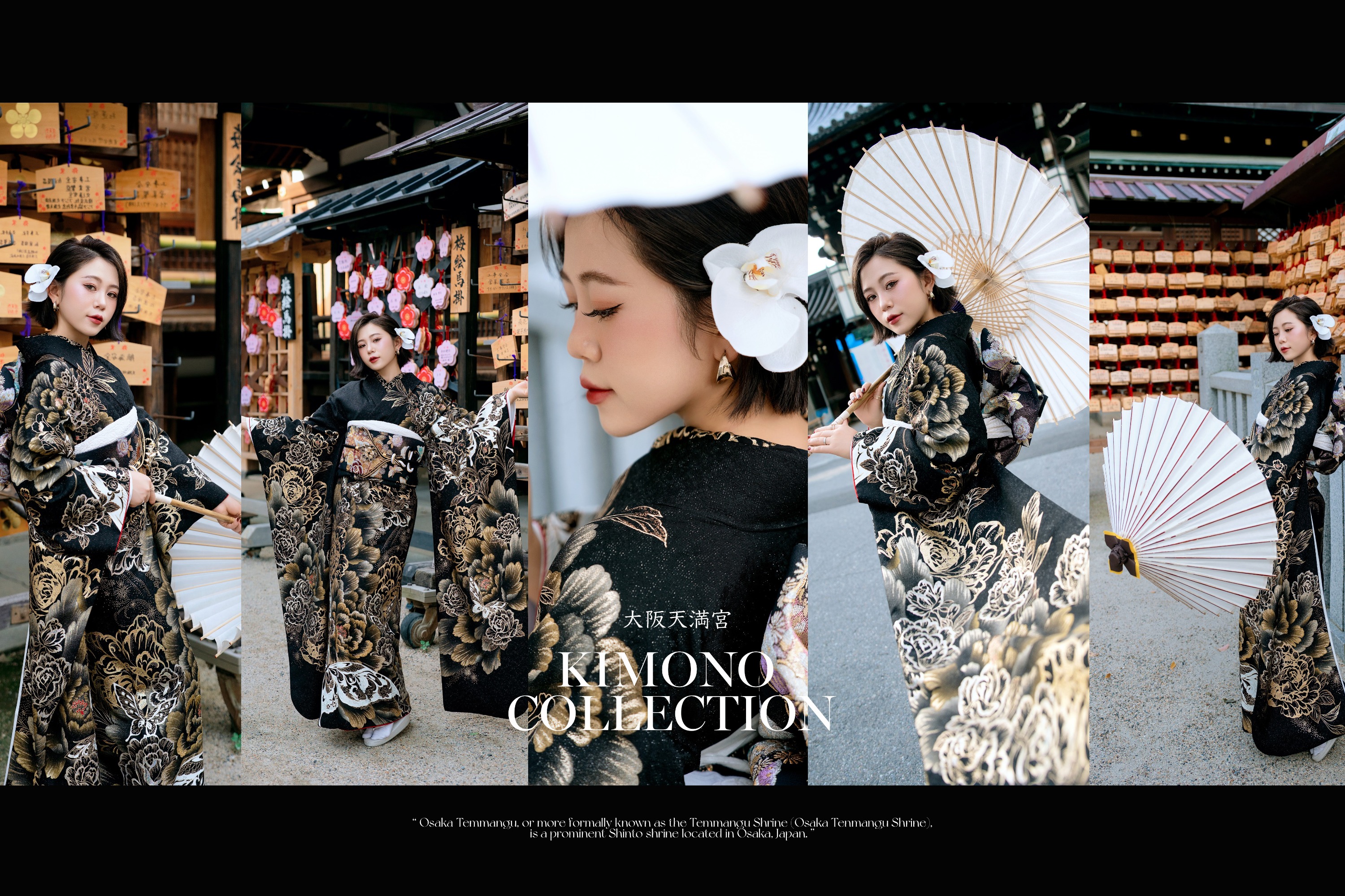
Kimono & Yukata Rental and Photo Shoot (Kyoto, Gion-Shijo, Yasaka Shrine) - Kimono Rental Misaki

Kyoto: Traditional Japanese Music Workshop with Shakuhachi
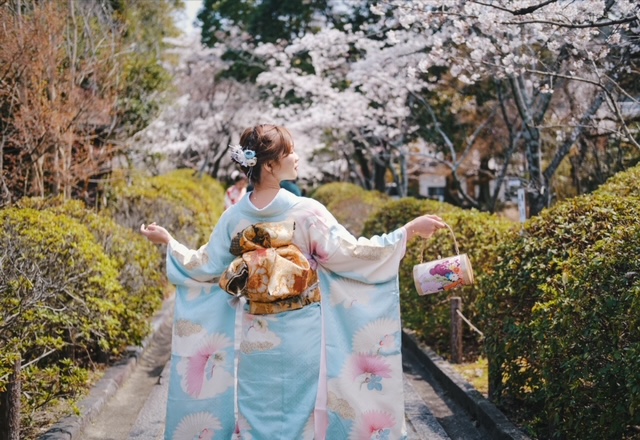
Kimono Rental (Kyoto/Provided by Kimono Rental Kanwa Yasaka Shrine)
Richmond Hotel Premier Kyoto Shijo
save ¥13,556 vs sell price
Check rateHilton Tokyo Narita Airport
save ¥7,910 vs sell price
Check rateOriental Hotel Okinawa Resort & Spa
save ¥5,889 vs sell price
Check rate#seasonal#planning#koyo#budget travel
Frequently Asked Questions
Is September a good time to visit Japan?
Yes, and it's underrated. Typhoon risk is real through mid-September, but hotel prices sit at their lowest point of the second half of the year and crowds are thin, since foliage season hasn't started and summer break has ended for most domestic travelers.
When does autumn foliage peak in Japan?
Hokkaido and the Tohoku mountains turn first, late September into October. Tokyo, Kyoto, and Osaka usually peak mid-to-late November, sometimes sliding into early December in the city center. Book the last two weeks of November 3-4 months ahead if Kyoto is the target.
Is December expensive in Japan?
The first three weeks are some of the cheapest of the year, foliage crowds have left and snow season hasn't started. Prices jump hard from December 28 through New Year, when much of Japan travels domestically and hotel rates in Tokyo, Osaka, and ski regions spike 40-80% above baseline.
Should I book Kyoto or Tokyo first for a November trip?
Kyoto first. Its foliage-season hotel inventory is smaller relative to demand than Tokyo's, and the famous spots (Arashiyama, Tofukuji, Eikando) sell out lodging 3-4 months ahead. Tokyo has more standing hotel stock and can be booked 6-8 weeks out without much price penalty.