Japan on $50 a Day 2026: Is It Actually Possible
¥8,090 ($50) a day, real numbers, no asterisks. Here’s what actually fits in that budget in Japan, and where it snaps.
Verified: August 27, 2026.
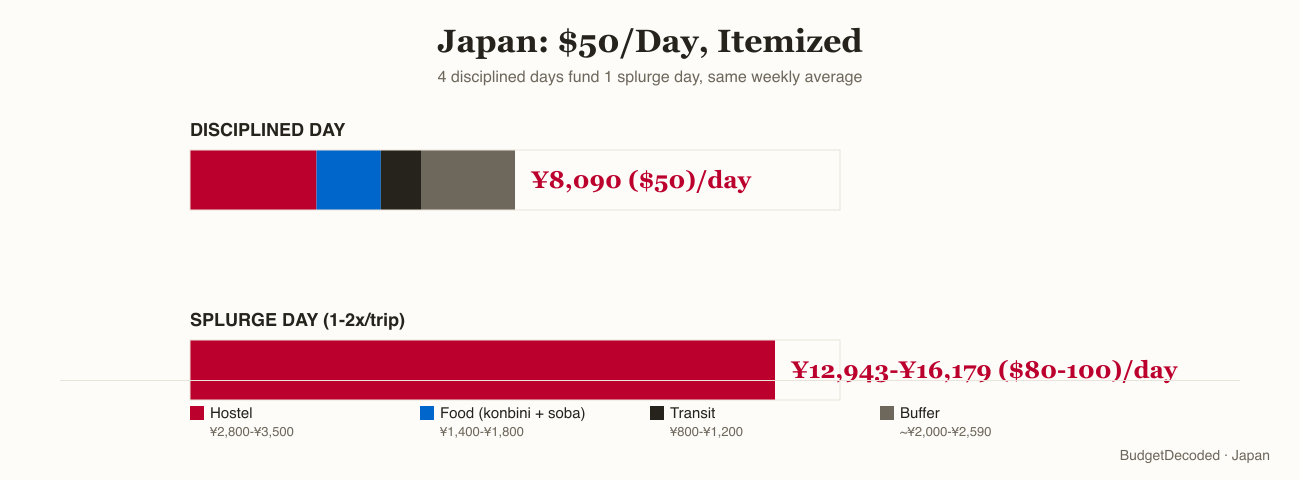
The ¥8,090 ($50) (¥1,213,425 ($7,500)) day, itemized
| Item | Cost | Notes |
|---|---|---|
| Hostel dorm bed | ¥2,800–3,500 | Capsule hotel as alternative |
| Breakfast + lunch (konbini) | ¥900–1,100 | Konbini system |
| Dinner (standing soba or gyudon) | ¥500–700 | Ticket-machine ordering, no Japanese needed |
| Transit (Suica, city day) | ¥800–1,200 | Depends on how much ground you cover |
| Subtotal | ~¥5,500 | Leaves ¥2,000 buffer |
That ¥2,000 buffer is your entire discretionary spend for the day: a snack, a coffee, or savings toward a paid activity later in the trip.
Where this works cleanly
Cities with dense hostel/konbini infrastructure. Tokyo, Osaka, and Kyoto all support this budget without much friction, hostels and konbini are everywhere, and Suica covers transit without cash fumbling.
Days with zero paid activities. Our free Tokyo list alone fills multiple days without spending a yen beyond food and transit, temples, parks, and neighborhood walking cost nothing.
Where it breaks
Paid activities. A single ¥3,000 experience (an onsen, a museum, a workshop) consumes 40% of the day’s entire budget. The math only holds if activities happen every 2-3 days, not daily, save the buffer days for them.
Alcohol and dining out. A couple of ¥600 beers or one restaurant dinner over ¥1,500 blows the food line entirely. This budget assumes konbini and standing-soba discipline, not izakaya nights.
Rural or resort regions. Okinawa’s transit costs more than mainland cities relative to what you get; our Okinawa budget guide runs closer to ¥9,707-¥11,325 ($60-70)))/day even with discipline.
The realistic version: ¥8,090 ($50) most days, ¥12,943-¥16,179 ($80-100))) splurge days
Rather than forcing every single day under ¥8,090 ($50), the pattern that actually survives a real trip: 4 days at ¥5,663-¥6,472 ($35-40))) (banking the surplus), 1-2 days at ¥12,943-¥16,179 ($80-100))) (the splurge, funded by the surplus). Same weekly average, better trip. Our 7-day ¥100,000 itinerary runs this exact structure.
Final thoughts
¥8,090 ($50)/day is possible, not a myth, but it’s a hostel-dorm-and-konbini number, not a hotel-and-restaurant number. Build in 1-2 splurge days funded by the disciplined ones rather than forcing every day under the line, that’s the version of this budget that survives contact with an actual two-week trip. Full daily cost math in our budget travel guide.
Verified as of August 27, 2026.
Book these while you’re there
Experience the Soul of Hiroshima: A Peaceful Koto Workshop

Dazaifu Tenmangu Shrine, Yufuin Town, Beppu Ropeway, Kamado Jigoku (with complimentary onsen egg and lemon soda) | Departing from Fukuoka

Samurai Training Experience KENDO in Osaka

Tokyo: Nikko Day Trip with Lake Chuzenji Boat Ride
VASARA Kimono and Yukata Rental in Fukuoka

Tokyo: Make Your Own Chopsticks Shibuya
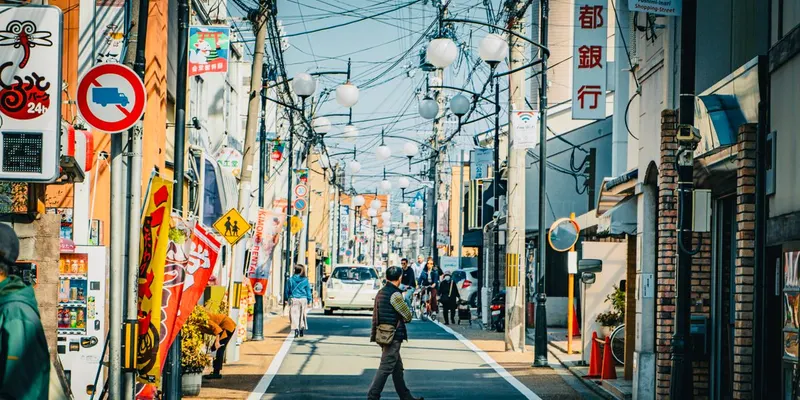
Enoshima: History,Culture,Views& 2h Hiking with a LocalGuide
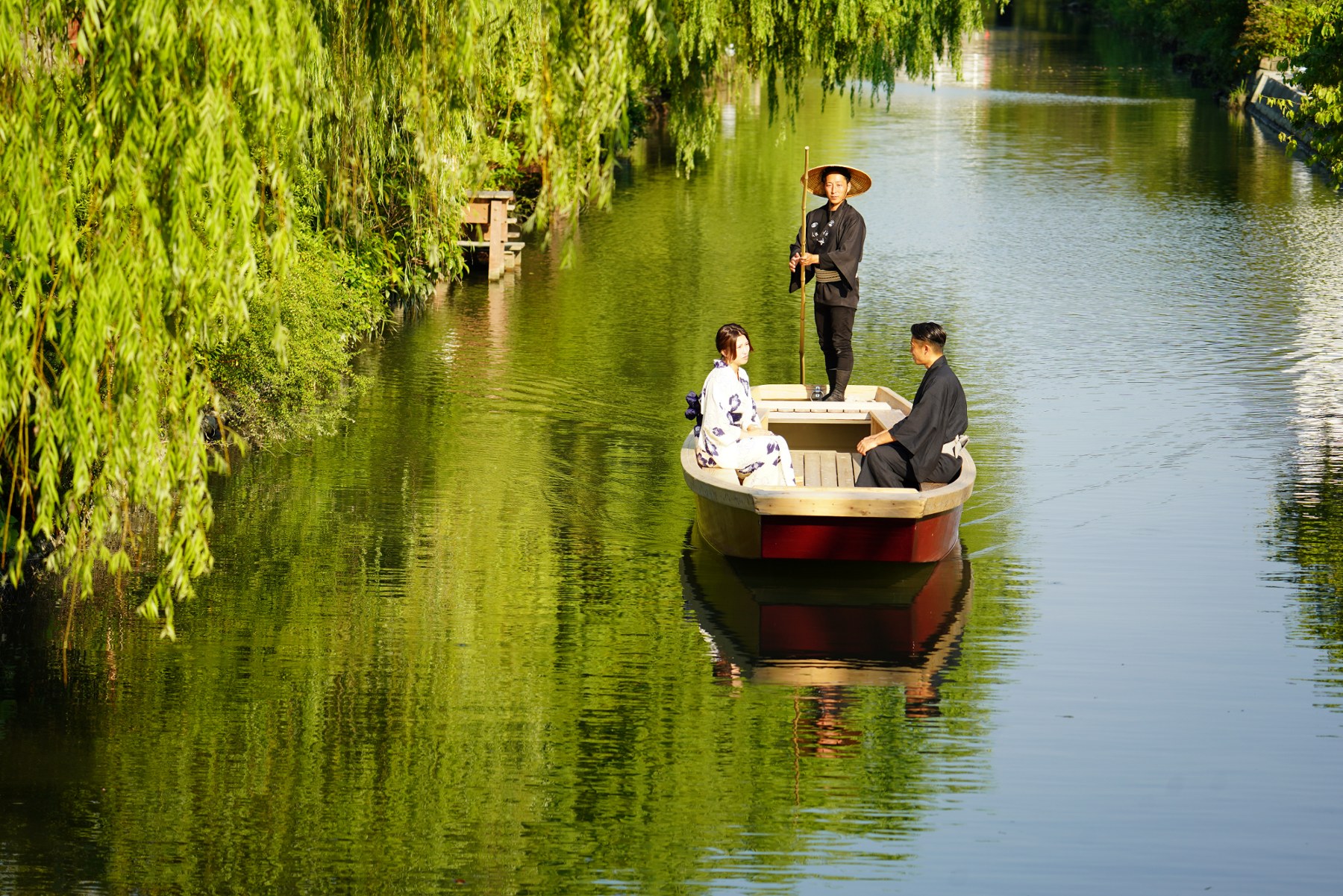
Yanagawa River Boating Experience (Shared/Private Course)
Richmond Hotel Premier Kyoto Shijo
save ¥13,556 vs sell price
Check rateHilton Tokyo Narita Airport
save ¥7,910 vs sell price
Check rateOriental Hotel Okinawa Resort & Spa
save ¥5,889 vs sell price
Check rate#budget travel#money saving#itinerary
Frequently Asked Questions
Is $50 a day enough for Japan in 2026?
Yes, in Tokyo/Osaka/Kyoto with disciplined choices: hostel dorm, konbini and standing-soba meals, Suica for transit, and skipping paid activities most days. It's tight, not miserable, roughly ¥7,500/day.
What breaks a $50/day Japan budget first?
Paid activities and alcohol. A single ¥3,000 experience or a couple of ¥600 beers can eat 40% of the day's budget. The system works if activities are rationed to every 2-3 days, not daily.
Can families or couples do $50/day in Japan?
¥8,090 ($50)/day per person, not per room, is the honest framing. Twin-share hostel or capsule rooms roughly halve the bed cost per person versus solo, which is where couples find the easiest savings versus a solo traveler on the same budget.