20 Natural Wonders in Vietnam
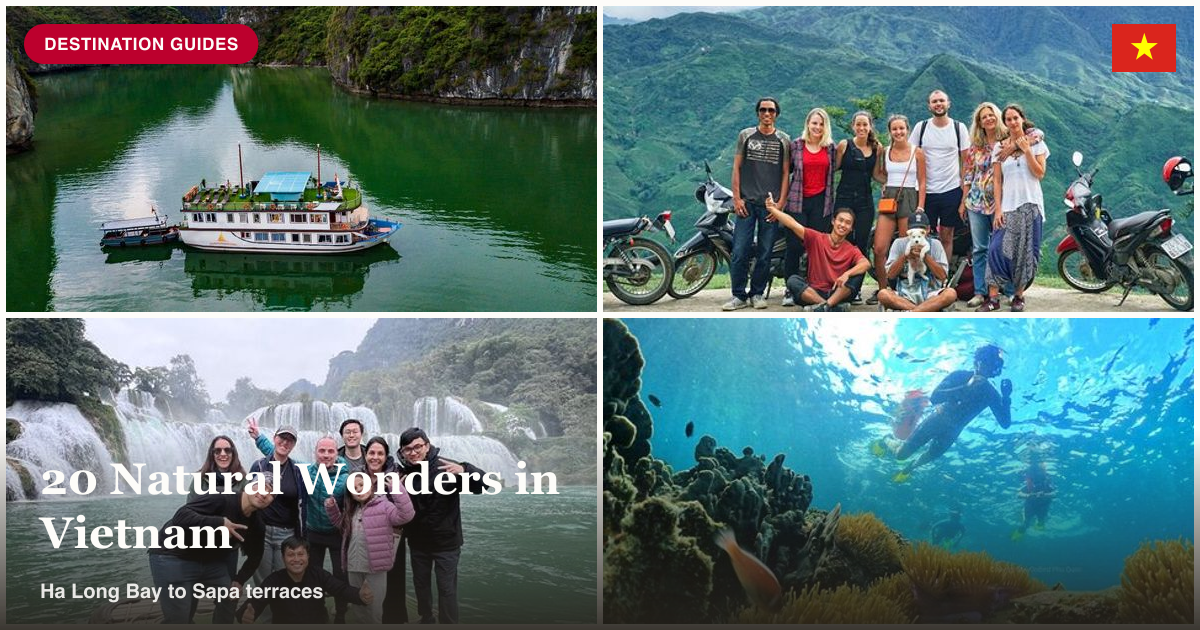
Vietnam’s natural wonders fall into three landscape categories: limestone karst, cave systems, and mountain terrain. Grouping them this way makes trip planning easier than a flat top-20 list, since karst and cave stops often sit near each other geographically.
Limestone karst and bay landscapes
Vietnam’s northern coast is built on limestone karst, thousands of years of erosion turning seabed into vertical islands.
- Ha Long Bay — thousands of limestone karsts rising from emerald water. An overnight cruise beats the day trip for this one specifically, rushing past the scenery is the main reason day-trippers come away unimpressed. Bookable through Klook, GetYourGuide, or Viator, which alone lists a dozen Ha Long Bay and Lan Ha Bay cruises out of Hanoi.
- Bai Tu Long Bay — Ha Long’s quieter neighboring bay, same karst formations, fewer boats.
- Cat Ba Island — the largest island in the Ha Long Bay area, karst cliffs meeting a national park.
- Trang An — inland karst scenery near Ninh Binh, boats threading through limestone caves and rice paddies rather than open sea.
- Tam Coc — Ninh Binh’s smaller-scale version of Trang An, rowboats through karst river caves.
- Lan Ha Bay — south of Ha Long, similar karst islets with fewer crowds and clearer water for swimming stops.
Verdict: if you can only fit one karst destination, make it Ha Long Bay for scale, but Trang An if you’d rather skip the boat crowds entirely.
Cave systems
Central Vietnam’s Phong Nha-Ke Bang region sits on some of the largest cave systems on the planet.
- Son Doong Cave — the world’s largest cave by volume, part of the Phong Nha system. Access requires the 4-day Oxalis expedition, around ₫78,643,410 ($3,000) per person including park fees, guides, and gear, capped at 10 people per group and roughly 1,000 permits a year. 2026 and 2027 dates are fully booked, 2028 is the earliest open slot.
- Phong Nha Cave — the accessible entry point to the wider cave system, boat rides through the cavern for travelers without an expedition booking.
- Paradise Cave — a dry, well-lit cave system with walkways, the easiest of the Phong Nha caves to visit on a standard day trip.
- Dark Cave — a smaller Phong Nha cave known for mud baths and zip-lining alongside the cave visit itself.
- Thien Duong Cave — another name used locally for Paradise Cave’s upper chambers, vast stalactite formations under artificial lighting.
Verdict: Paradise Cave covers the “see a massive cave system” box for most travelers. Son Doong is a bucket-list expedition, not a day-trip add-on, and with 2026-2027 sold out, book 2028 now if it’s the goal rather than assuming a spot will open up closer to your trip.
Mountain and terrace landscapes
The northern highlands trade karst and cave for elevation, terraced hillsides carved by ethnic minority communities over generations.
- Sapa rice terraces — terraced hillsides and minority villages around Sapa town, the base for multi-day treks through the terrain.
- Fansipan — the highest peak in Indochina, reachable by cable car from Sapa for those not trekking the summit route. The upper station now includes Ban May, a cultural village recreating H’Mong, Dao, and Tay village life, worth the extra hour for travelers who cable-car up and skip the trek.
- Mu Cang Chai — terraced rice fields further from Sapa, less touristed, best in the September-October harvest window when the terraces turn gold.
- Ha Giang Loop — a mountain road circuit through the far north, karst peaks and terrace valleys combined along one motorbike route.
- Bac Ha highlands — rolling hill terrain near the Chinese border, quieter than Sapa’s main trekking circuit.
- Ba Be Lake — Vietnam’s largest natural lake, set inside limestone mountains in the northeast.
Verdict: Sapa is the accessible version of this landscape category, Ha Giang and Mu Cang Chai are the versions worth the extra travel time if you’ve already done Sapa once.
Delta and coastal landscapes
- Mekong Delta — floating markets and canal-side villages south of Ho Chi Minh City, usually a one- or two-day boat tour.
- Phu Quoc coastline — Vietnam’s largest island, beach and forested interior rather than karst or cave terrain.
- Cham Islands — a small island cluster off Hoi An, reef and beach landscape reachable as a day trip from the old town.
Verdict: the Mekong Delta earns its spot for the floating markets specifically, the canal scenery alone doesn’t justify the trip if markets aren’t running that day.
How much time does each landscape category actually need?
These three categories don’t compress the same way, worth knowing before you build a schedule around them:
| Category | Minimum time to do it justice |
|---|---|
| Limestone karst and bay | 1 overnight (Ha Long Bay) or half a day (Trang An, Tam Coc) |
| Cave systems | Half a day for Paradise Cave, multiple days for a Son Doong expedition |
| Mountain and terrace | 2-3 days minimum for a Sapa trek, longer for Ha Giang’s full loop |
| Delta and coastal | 1-2 days for the Mekong, standalone multi-day trip for Phu Quoc |
Verdict: karst and delta stops fit into a standard two-week route without much strain. Cave expeditions and mountain treks are the two categories that need dedicated time carved out in advance, don’t assume they slot in around everything else.
Planning around these landscapes
Karst and cave stops cluster in the north and center, so they fit naturally into the north-to-south route most first-time trips already follow. Mountain terrain adds real time (Sapa treks run multiple days), factor that into your overall trip length rather than treating it as a quick add-on.
Getting between clusters matters too. The Reunification Express sleeper train connects the karst-heavy north to central Vietnam’s cave country, with stops at Hue and Da Nang along the way, a scenic if slower alternative to flying between regions.
For a region-by-region version of this list rather than landscape-by-landscape, see the 15 scenic destinations breakdown. If you’re narrowing down which of these are actually worth a detour versus which to skip, the 25 bucket list attractions post gives a verdict on each.
Which of these should a first-timer actually prioritize?
With 20 entries across four categories, not every landscape needs to make a first trip. If you’re building a route from scratch, weight it this way: one karst destination (Ha Long Bay or Trang An), one cave stop (Paradise Cave covers this without an expedition booking), and one mountain leg (Sapa) covers the range of Vietnam’s natural scenery without overloading a two-week trip.
Everything else on this list is a strong second-trip or extra-time addition rather than a first-trip requirement. Mu Cang Chai, Ha Giang, and Son Doong specifically reward travelers who’ve already done the accessible version once and are looking for something further off the standard circuit. Pair that reasoning with the family attractions guide if you’re traveling with kids, several of these landscapes (Son Doong, Ha Giang) aren’t built for young children regardless of how they rank scenically.
Book these while you’re there

Hoi An: Candle-Making Workshop with Garden Tour & Drink

Sun World Hon Thom Ticket

Number one top rated ethical cultural trekking and homestay by ETHOS
Hoi An: Romantic Dining Experience on a Bamboo Raft

Sun World Fansipan Legend Ticket

Hanoi Motorbike Tour: Hanoi HIGHTLIGHTS & HIDDEN GEMS
Ho Chi Minh City: Guided Sunrise Photography Tour

VinWonders Nha Trang Ticket
#natural wonders#landscapes#outdoors
Frequently Asked Questions
What is Vietnam's most famous natural wonder?
Ha Long Bay, thousands of limestone karsts rising out of emerald water. It's the one landscape most people picture when they think of Vietnam, and an overnight cruise is the way to see it properly rather than a rushed day trip.
What is Son Doong and can regular travelers see it?
Son Doong, inside the Phong Nha-Ke Bang system, is the largest cave in the world by volume. It requires the 4-day Oxalis expedition (around ₫78,643,410 ($3,000)/person, capped at 10 people per group), and 2026-2027 dates are already fully booked, 2028 is the earliest open slot. Travelers without that booking still get strong cave experiences at Paradise Cave and the other smaller, easier-to-access caves nearby.
Are Vietnam's rice terraces natural or man-made?
Man-made but landscape-scale, terraced over generations by ethnic minority communities in the northern mountains around Sapa. They function as a natural wonder visually even though the shaping is entirely human.
Is Ha Long Bay worth visiting if you've already seen limestone karsts elsewhere in Southeast Asia?
Yes, the scale is different, thousands of islets across a bay rather than a cluster. Pair it with Phong Nha's caves rather than skipping straight past, the karst-and-cave combination is specific to this stretch of Vietnam.