APA vs Toyoko Inn vs Dormy Inn 2026: Chains Compared
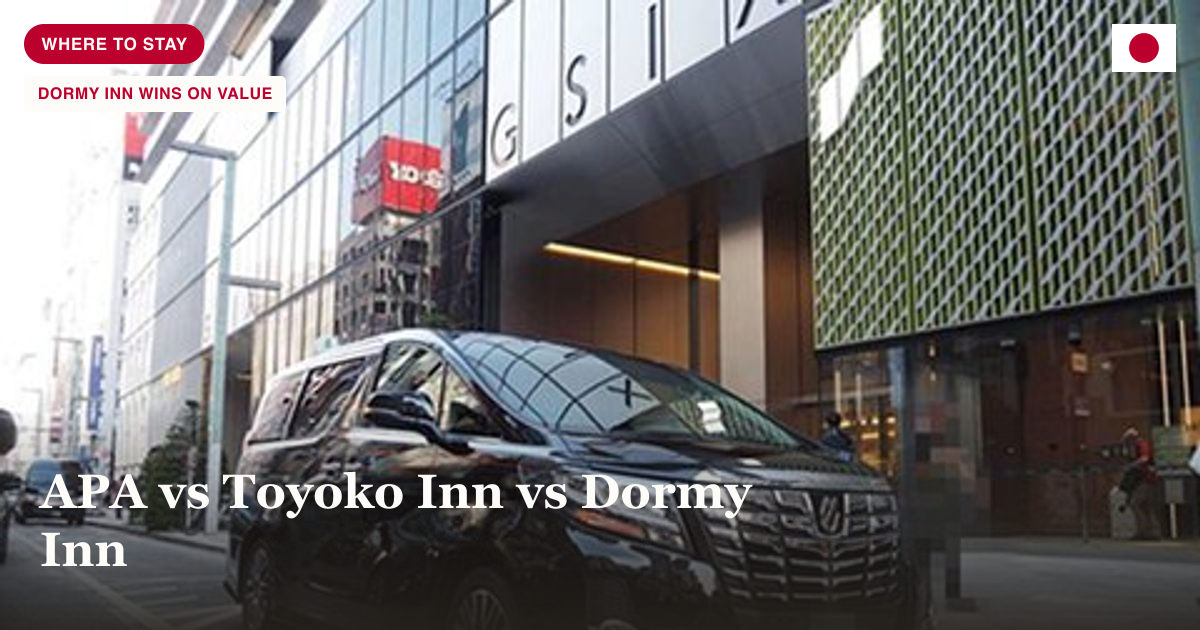
Six chains run most of budget Japan’s beds, and once you can read them, you can book any city blind: the room will be small, spotless, and exactly what the chain always builds. Here’s the decoder, with 414 tracked hotels behind the numbers.
Rates checked: September 8, 2026.
The chain decoder
| Chain | Tracked from | The deal |
|---|---|---|
| APA | ¥6,253 ($38.65) (Asakusa) | Everywhere; smallest rooms; big-bath towers |
| Toyoko Inn | ¥6,561 ($40.55) (Kyoto) | Free breakfast; identical everywhere |
| Sotetsu Fresa | ¥6,341 ($39.19) (Nagoya) | Station-adjacent specialists |
| Dormy Inn | ¥10,694 ($66.10) (Osaka) | Rooftop onsen + free midnight ramen |
| Candeo | ¥11,204 ($69.25) (Nagasaki) | 4★ polish, sky-floor baths |
| MYSTAYS / KOKO / Vessel | ¥11,325 ($70)-ish | Modern renovators, city-dependent |
The three that matter most
APA, 17 tracked properties, the density champion. Rooms are the smallest of the set (a bed with walls), but there’s an APA beside every station and it holds inventory on nights everything else sold out. The big-bath towers (look for “Daiyokujo” in listings) redeem the room size. Book it for: last-minute nights, one-night hops, station-adjacency.
Toyoko Inn, the standardization play: every property identical down to the pillow, free simple breakfast (onigiri, miso, coffee), pricing honest everywhere. The ¥300-saved-is-¥300 philosophy as a hotel. Book it for: multi-city trips where zero surprises is the feature.
Dormy Inn, the budget-ryokan hybrid: rooftop onsen baths (real ones, the daiyokujo tier built into your hotel) and free yonaki ramen at 9:30–11 PM nightly. Costs ¥3,236 ($20) more than APA and returns it in bath and noodles. Book it for: winter trips, Hokkaido, any stay where the evening bath IS the plan.
The supporting cast: Sotetsu Fresa owns station exits (Nagoya’s ¥6,310 ($39) pair, Tokyo’s Ginza/Kanda deals); Candeo is the “cheap 4★” tier (the ¥5,485 ($33.90) RIHGA-class deals hunt in this band); Route Inn/KOKO/Vessel fill the provincial cities (Fukuoka’s board shows the mix).
Reading any listing in 10 seconds
- “Daiyokujo/large bath” = the perk that matters; prioritize it in winter.
- Room size 11–14m² = normal, not a scam. Couples: book “double” (140cm bed) minimum, “twin” for actual space.
- “Ekimae/Eki-guchi” in the name = station-front, the transit-day pick.
- Breakfast math: free (Toyoko) > konbini > ¥2,000 buffets unless it’s Dormy/Candeo tier.
Final thoughts
Trip formula: Toyoko/APA/Fresa for the workhorse nights, one Dormy for the bath-and-ramen night, deal-hunt the Candeo band for the treat. The chains’ consistency is the budget traveler’s infrastructure, every city, pre-solved. Browse current rates city by city: the destination hubs. None of these chains sell activities, for that, Klook, GetYourGuide, and Viator cover the daytime side of the same trip.
The full sleep stack: capsules · ryokan strategy · Tokyo / Osaka / Kyoto deals.
Rates checked as of September 8, 2026; hotel prices change daily.
Book these while you’re there
Experience the Soul of Hiroshima: A Peaceful Koto Workshop
Dazaifu Tenmangu Shrine, Yufuin Town, Beppu Ropeway, Kamado Jigoku (with complimentary onsen egg and lemon soda) | Departing from Fukuoka

Samurai Training Experience KENDO in Osaka
Tokyo: Nikko Day Trip with Lake Chuzenji Boat Ride
VASARA Kimono and Yukata Rental in Fukuoka

Tokyo: Make Your Own Chopsticks Shibuya
Enoshima: History,Culture,Views& 2h Hiking with a LocalGuide
Yanagawa River Boating Experience (Shared/Private Course)
Richmond Hotel Premier Kyoto Shijo
save ¥13,556 vs sell price
Check rateHilton Tokyo Narita Airport
save ¥7,910 vs sell price
Check rateOriental Hotel Okinawa Resort & Spa
save ¥5,889 vs sell price
Check rateFrequently Asked Questions
What is the best budget hotel chain in Japan?
Dormy Inn for the experience (rooftop onsen baths plus free late-night ramen), Toyoko Inn for pure value with free breakfast, APA for sheer coverage and last-minute availability. All three deliver clean, small, reliable rooms, the differences are the perks.
Why are Japanese business hotel rooms so small?
They are built for solo overnight workers: 10 to 14 square meters fitting a semi-double bed, desk, and full wet-room bathroom. Everything works, nothing is spacious. Couples should book twin or double categories, not single rooms.
Do Japanese business hotels include breakfast?
Toyoko Inn includes a simple free breakfast at every property; Dormy Inn and Candeo sell strong buffets at ¥1,500 to 2,500; APA usually charges separately. A konbini breakfast beats paying at the low end.
Are business hotels better than hostels in Japan?
At ¥6,148 ($38) to ¥8,090 ($50) for a private room with bathroom, business hotels beat hostel dorms for pairs and anyone valuing privacy, two dorm beds often cost the same. Solo travelers on the tightest budgets still save with dorms at ¥2,500 to 3,500.