Getting Around Hong Kong: Octopus Card & MTR Guide
Buy an Octopus card at the airport within your first ten minutes in Hong Kong, it covers the MTR, buses, trams, and the Star Ferry, and doubles as payment at convenience stores. Everything else in this guide is detail on top of that one decision.
The Octopus card: mechanics, not just the pitch
The Octopus card is a stored-value smart card, tap it at any gate or reader and the fare deducts automatically, no ticket, no calculating a fare table. Buy one at any MTR station customer service counter or at the airport on arrival, standard cards run a small deposit on top of whatever value you load, refundable when you return the card before flying home (a small deduction applies if you return it within three months of first use, full refund after that window).
Topping up: cash at any MTR station’s Add Value Machine, or by card at newer machines and via the Octopus app if you’ve linked a payment method. There’s no minimum top-up beyond the machine’s smallest note acceptance, and no maximum that matters for a normal trip, load HK$150-200 (roughly HK$149-HK$204 ($19-26))) for a full day of MTR, bus, and ferry use and top up again when the balance runs low, machines show your remaining balance on every tap.
Where it works beyond transit: convenience stores (7-Eleven, Circle K), many fast-food chains, some vending machines, and parking meters. It functions as genuine everyday payment, not just a transit pass, worth remembering if you’re short on cash for a small purchase.
The MTR: Hong Kong’s actual backbone
The MTR reaches nearly every neighborhood on a typical itinerary, and lines are color-coded and clearly signed in English and Chinese at every station. A few lines matter more than others for first-time visitors:
| Line | Color | Connects |
|---|---|---|
| Island Line | Blue | Central, Causeway Bay, across Hong Kong Island’s north shore |
| Tsuen Wan Line | Red | Tsim Sha Tsui, Mong Kok, Central (via harbor crossing) |
| Kwun Tong Line | Green | Yau Ma Tei, Kowloon’s eastern side |
| Tung Chung Line | Orange | Tung Chung (Lantau’s Ngong Ping/Big Buddha gateway) |
| Airport Express | Teal | Airport to Central, fastest airport transfer |
| Disneyland Resort Line | Pink | Sunny Bay to Hong Kong Disneyland |
The Tsuen Wan and Island lines together cover roughly 80% of a standard first-time itinerary’s movement, Tsim Sha Tsui to Central, Mong Kok to Causeway Bay. The Tung Chung Line is the one to know specifically if Lantau’s Big Buddha is on your route, it’s the fastest way to Tung Chung station before switching to the Ngong Ping 360 cable car.
Star Ferry: routes, fares, and why it’s not just transport
The Star Ferry runs two main tourist-relevant routes: Tsim Sha Tsui to Central, and Tsim Sha Tsui to Wan Chai, both crossing Victoria Harbour in about 8-10 minutes. Fares are Octopus-compatible and among the cheapest transit anywhere in the world for the view delivered, a genuine sightseeing experience priced as basic transport. Ferries run roughly every 6-12 minutes depending on time of day, no need to check a schedule in advance, just walk to the pier.
Take it both directions if you have time, morning crossings work for orientation, seeing how Hong Kong Island and Kowloon relate to each other at water level, while evening crossings deliver the skyline-lights view most people picture when they think “Star Ferry.” For the fuller comparison of this against paid observation decks, see our observation decks and viewpoints guide.
Buses: when the MTR doesn’t reach
Buses fill the gaps the MTR doesn’t cover, Hong Kong Island’s southern beaches (Shek O, Repulse Bay), parts of the New Territories, and most airport transfers. Octopus works on every bus exactly like the MTR, tap on boarding, and most buses show the next few stops on an electronic display. Double-decker buses are standard and worth taking the upper front seat on if one’s available, a street-level view the MTR’s underground tunnels can’t offer.
Airport transfers: three real options
Booking the flight into HKG itself, Trip.com is worth a look before any of the three transfer options below even come up, it carries a wide spread of Hong Kong-bound routes.
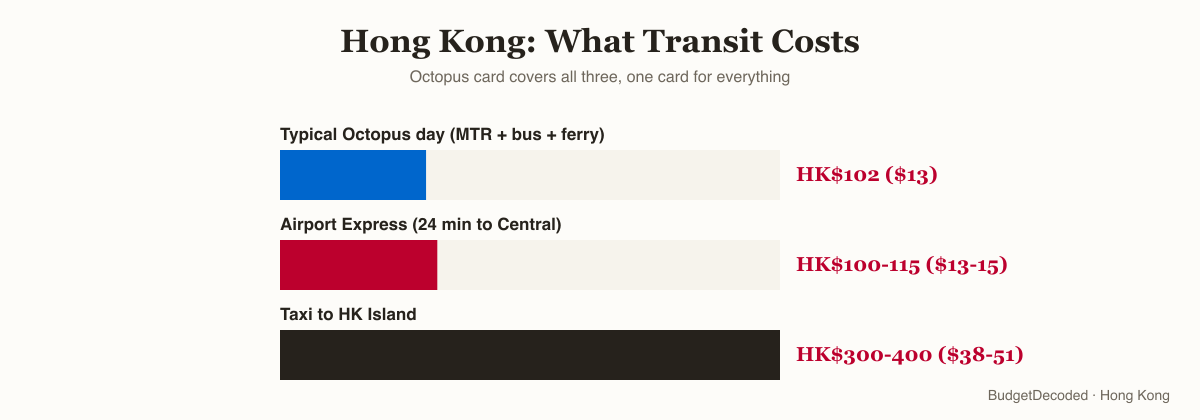
Airport Express (fastest): roughly 24 minutes to Central via the Tung Chung Line’s express counterpart, HK$100-115 (about HK$102-HK$118 ($13-15))) one-way, Octopus-compatible. The premium option if time matters more than cost, our Octopus vs Airport Express guide breaks down the full arrival math against a taxi and bus.
A-series airport buses (cheapest): direct routes to Hong Kong Island, Kowloon, and the New Territories, 60-90 minutes depending on traffic and destination, a fraction of the Airport Express fare. Octopus works here too.
Taxi: metered, roughly HK$300-400 (about HK$298-HK$400 ($38-51))) to Hong Kong Island depending on traffic and exact destination, useful late at night when transit frequency drops or with heavy luggage.
Ding Ding trams: slow on purpose
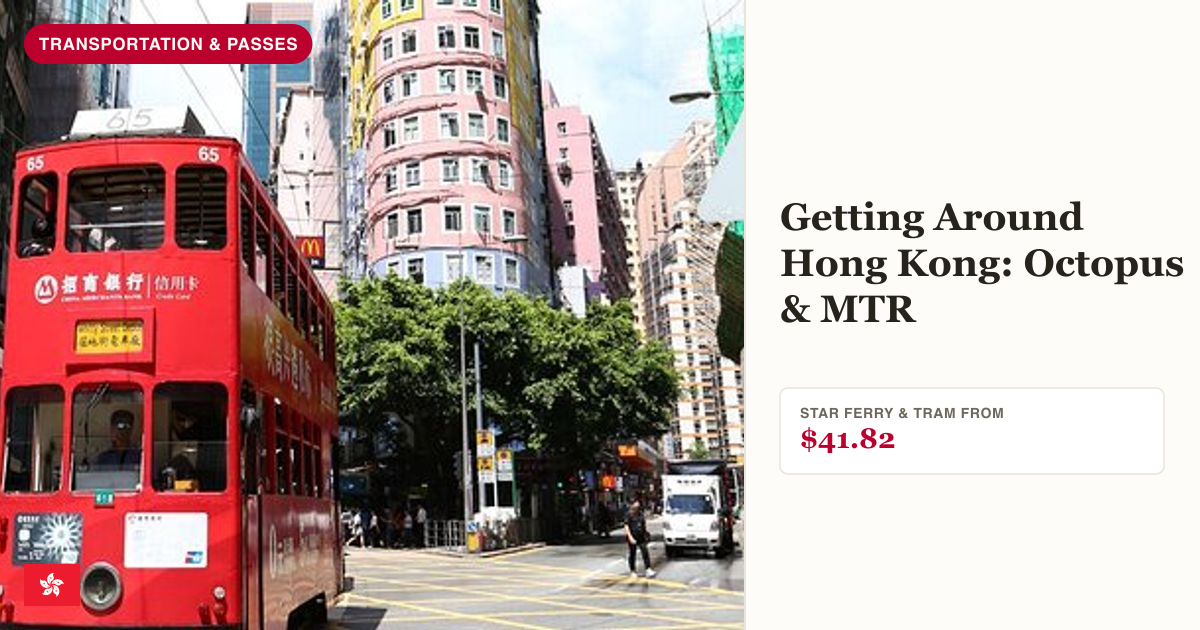
Hong Kong Island’s century-old street-level trams run along the north shore from Kennedy Town to Shau Kei Wan, Octopus-compatible, and priced far below the MTR for a comparable short hop. They’re slower than the MTR by design, the appeal is the street-level view rather than speed, worth taking once for the experience even though it’s not the efficient way to cross the island. Covered in more depth in our landmarks and hidden gems guide.
A one-day transit budget, roughly
A typical day mixing MTR rides, one Star Ferry crossing, and a bus or tram ride runs well under HK$100 (about HK$102 ($13)) on Octopus for a single traveler, transit is one of the cheapest parts of a Hong Kong trip relative to food and hotels. Load your Octopus card once in the morning and you’ll rarely need to think about fares again until the balance runs low, the tap-and-go system is built specifically to remove that friction.
Single-journey tickets vs Octopus: don’t bother with paper
The MTR still sells single-journey paper tickets from platform machines, but there’s no real reason to use them over Octopus, paper tickets cost the same or more per ride, require calculating your exact fare and destination at a machine before every trip, and don’t work on buses, trams, or the Star Ferry at all. The only scenario where a paper ticket makes sense is a single MTR ride taken before you’ve bought an Octopus card, which shouldn’t happen if you get one at the airport as this guide recommends.
QR code and app-based alternatives
Hong Kong’s transit system has also rolled out QR-code payment options through the MTR Mobile app and some contactless bank cards work directly at gates without an Octopus card at all. Neither is necessary for a short trip, Octopus remains simpler for a visitor since it needs no app setup or bank card configuration, just tap and go from the moment you buy it. Stick with the physical card unless you have a specific reason to prefer app-based payment.
How this differs from our ultimate guide
Our ultimate guide to where to go mentions the Octopus card briefly as part of a broader first-timer overview. This guide is the deep version, MTR line specifics, Star Ferry route fares, bus logistics, and airport transfer math, read this one before you land if transit planning specifically is what you’re after, and use the ultimate guide for the rest of the trip’s structure.
Fares verified as of September 8, 2026, Octopus and MTR pricing is adjusted periodically, confirm current rates via the MTR Mobile app on arrival.
Book these while you’re there

Hong-Kong: Island-Hopping Volcanic Rocks Yacht Tour + Snacks

Dining Offers at Hong Kong Disneyland Resort

Big Bus Hong Kong Open Top Hop-On Hop-Off Sightseeing Tour
Hong Kong Private Tour by Luxury 7‑Seater with Top Guide
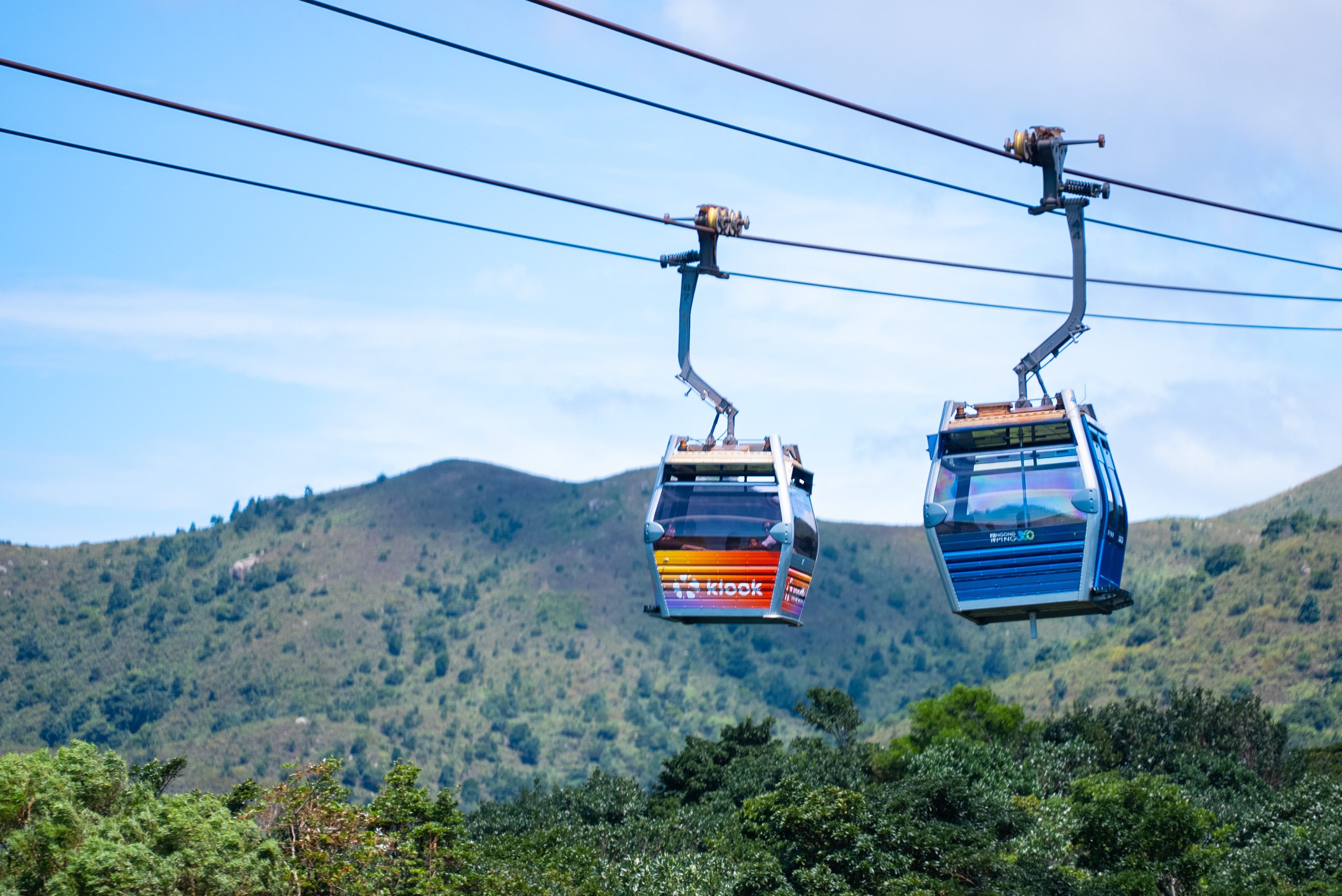
Ngong Ping 360 Cable Car Ticket in Hong Kong

Hong Kong International Airport Plaza Premium Lounge Access

Hong Kong Airport: Plaza Premium First Airport Lounges
#hong kong#octopus card#mtr#transportation
Frequently Asked Questions
Do I need a separate ticket for the Star Ferry if I have an Octopus card?
No. The Octopus card covers the Star Ferry directly, tap in and out the same as an MTR gate, no separate paper ticket needed at any of its three routes.
How much should I top up my Octopus card with?
HK$150-200 (about HK$149-HK$204 ($19-26))) covers a full day of MTR, bus, and ferry rides with room to spare. Balances carry over and are refundable at MTR stations before you fly home, so overloading it isn't a real risk.
Is the Airport Express worth it over a cheaper airport bus?
For time, yes, Airport Express reaches Central in about 24 minutes versus 60+ on a bus. For budget, the A-series airport buses cost a fraction of the Airport Express fare and work fine if you're not in a hurry on arrival.
Can tourists use the same Octopus card as residents?
Yes, the standard Octopus card works identically for visitors and residents. Some tourist-specific versions bundle small discounts or souvenir designs, but the functional card is the same one everyone taps at every gate.