Shūbun no Hi 2026: Japan's Autumnal Equinox Day Explained
Shūbun no Hi, Japan’s Autumnal Equinox Day, falls on September 23, 2026, a Wednesday. It’s a national public holiday, not tied to a fixed date like most, it lands on whatever day the actual astronomical equinox occurs. Banks and government offices close; shops, trains, and temples run as normal, just busier.
Verified: September 13, 2026.
What Shūbun no Hi actually is
The holiday’s roots go back to the Shinto court ritual Shūki kōreisai, an imperial rite honoring ancestral spirits observed since at least the Heian period (794-1185). After World War II, Japan’s postwar constitution separated religion from state functions, so in 1948 the holiday was repackaged as the secular Autumnal Equinox Day, keeping the ancestor-honoring spirit without the state Shinto framing.
Unlike Golden Week’s fixed late-April dates, Shūbun no Hi tracks the real astronomical event: the moment the sun crosses the celestial equator heading south. Japan’s National Astronomical Observatory calculates the exact date each year, and the government doesn’t officially gazette it until February of the year before, which is why some calendars list Autumnal Equinox Day for a future year as “TBC.” In 2024 it fell on September 22; in 2025 and 2026 it lands on September 23.
Ohigan: the week the holiday sits inside
Shūbun no Hi is the midpoint of Ohigan (お彼岸), a seven-day Buddhist observance running three days before and three days after the equinox itself.
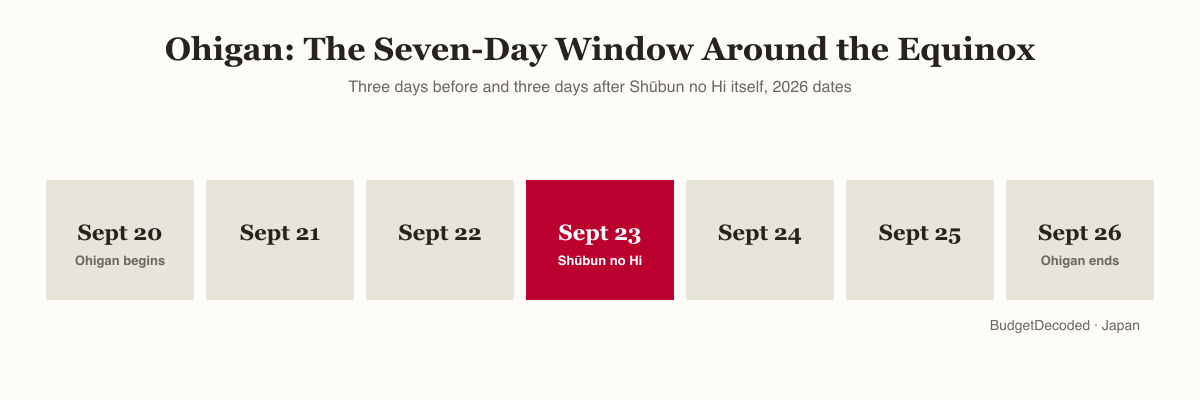
“Higan” means “the other shore,” a Buddhist reference to enlightenment, reached by way of six practices (the paramitas): generosity, morality, perseverance, concentration, meditation, and wisdom. Because day and night split evenly on the equinox, the moment was traditionally read as the boundary between this world and that “other shore” being at its thinnest, making it the natural time to tend to ancestors’ graves and reflect on those six practices.
During Ohigan week, families across Japan visit ancestral graves (haka mairi), clean the headstones, and leave flowers and incense. Temples hold special services, and it’s one of the two busiest grave-visiting periods on the calendar alongside Obon in August.
The food: ohagi
The equinox has its own traditional sweet, ohagi, a mochi rice cake wrapped in sweet azuki bean paste, sometimes rolled in roasted soybean flour (kinako) instead. The same sweet shows up at the spring equinox (Shunbun no Hi) under a different name, botamochi, named after spring’s peony (botan) blossoms rather than autumn’s bush clover (hagi). Same dessert, different seasonal name, a small detail that trips up a lot of first-time visitors reading Japanese confectionery shop signs in September versus March.
What’s actually open or closed
Shūbun no Hi is a public holiday for people, not a retail shutdown. Banks, post offices, and government offices close for the day; nearly everything a traveler interacts with stays open.
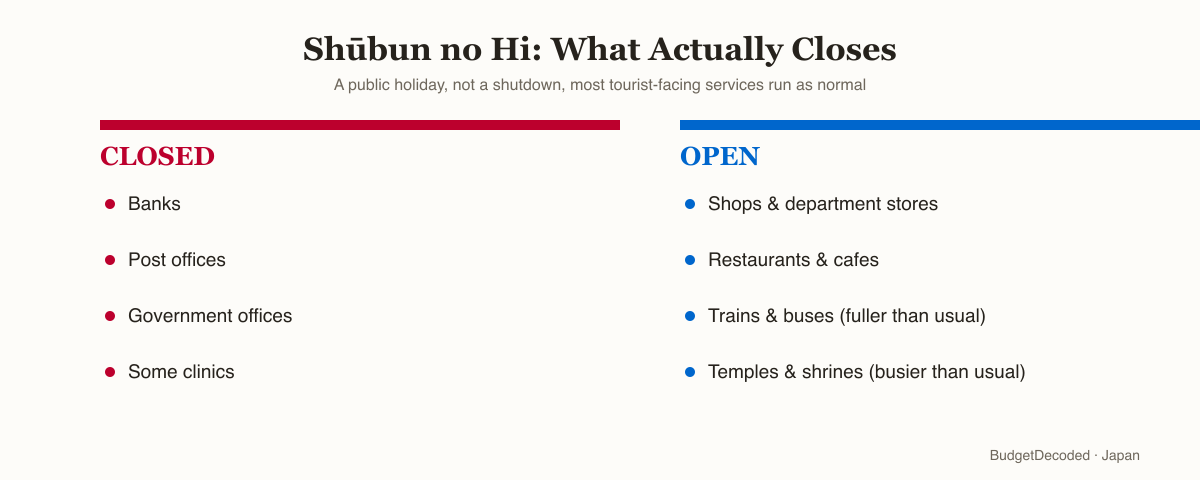
The practical impact for visitors is crowding, not closures. Temples and shrines run busier than a normal Wednesday since families are visiting graves and holding services. Trains fill up too, not because of Shūbun no Hi alone but because it’s the final day of Japan’s 2026 Silver Week.
How this ties into Silver Week 2026
2026 is a Silver Week year: Respect for the Aged Day (September 21) sits two days from Shūbun no Hi (September 23), and the working day squeezed between them, September 22, becomes a mandated day off by law, creating a five-day run from September 19 to 23. That’s the same rare holiday cluster covered in our Silver Week Japan guide, which breaks down the crowd and price spike across specific cities like Kanazawa and Beppu in more detail than this post does.
Two additional factors are stacking onto this year’s crowding specifically. First, Nozomi shinkansen trains run all-reserved with zero unreserved cars from September 18 through 23, confirmed by both JR Central and JR West, meaning walk-up seating isn’t an option on Japan’s fastest bullet train line for the entire window. Second, the Asian Games opens in Aichi-Nagoya on September 19 and runs through October 4, adding non-holiday-related demand for Nagoya-area hotels and trains that will still be tight well after Silver Week itself ends.
Should tourists plan around it?
If your trip already lands in Japan during this window, Shūbun no Hi itself doesn’t require special planning the way a full-shutdown holiday would, shops and restaurants operate normally. What it adds to Silver Week is temple and shrine crowding specifically, if a visit to a major temple (Kyoto’s Fushimi Inari, Tokyo’s Sensoji) sits on your itinerary for September 23, expect it busier than an ordinary weekday, families performing Ohigan visits stack on top of the usual tourist traffic.
For anyone routing a trip around the holiday rather than just landing inside it, the Golden Week guide covers the spring equivalent for comparison, and the when-to-go budget math post covers how shoulder-season timing shifts pricing across the year more broadly. Late September also sits right at the start of autumn foliage season further north, worth checking if you’re deciding whether to extend a Silver Week trip by a week or two.
Final thoughts
Shūbun no Hi is a genuine cultural observance, not a tourist event, and most of what a visitor notices is secondhand: busier temples, fuller trains, and ohagi appearing in convenience store dessert cases for a couple of weeks. It’s worth understanding on its own terms rather than only as “the last day of Silver Week,” the Ohigan tradition behind it is one of the more quietly consistent threads running through Japanese cultural life, observed the same way twice a year since long before it had a government holiday attached to it.
Verified as of September 13, 2026.
Book these while you’re there
Experience the Soul of Hiroshima: A Peaceful Koto Workshop

Dazaifu Tenmangu Shrine, Yufuin Town, Beppu Ropeway, Kamado Jigoku (with complimentary onsen egg and lemon soda) | Departing from Fukuoka

Samurai Training Experience KENDO in Osaka
Tokyo: Nikko Day Trip with Lake Chuzenji Boat Ride
VASARA Kimono and Yukata Rental in Fukuoka

Tokyo: Make Your Own Chopsticks Shibuya
Enoshima: History,Culture,Views& 2h Hiking with a LocalGuide
Yanagawa River Boating Experience (Shared/Private Course)
Richmond Hotel Premier Kyoto Shijo
save ¥13,556 vs sell price
Check rateHilton Tokyo Narita Airport
save ¥7,910 vs sell price
Check rateOriental Hotel Okinawa Resort & Spa
save ¥5,889 vs sell price
Check rate#shubun no hi#autumnal equinox#ohigan#seasonal
Frequently Asked Questions
What is Shūbun no Hi?
Japan's Autumnal Equinox Day, a national public holiday that falls on the actual date of the astronomical equinox each year, September 23 in 2026. It's dedicated to honoring ancestors and marks the midpoint of the seven-day Buddhist Ohigan observance.
When is Autumnal Equinox Day in 2026?
September 23, 2026, a Wednesday. Combined with Respect for the Aged Day on September 21, it creates the five-day Silver Week window running September 19-23.
Is everything closed in Japan on Shūbun no Hi?
No. Banks, post offices, and government offices close, but shops, restaurants, trains, and temples all stay open, many running busier than usual. It's a holiday for people, not a shutdown of tourist-facing services.
Why doesn't Shūbun no Hi fall on the same date every year?
The date is set by the actual astronomical equinox, not a fixed calendar day, so it shifts between September 22 and 23 depending on the year. Japan's National Astronomical Observatory calculates it and the government doesn't officially confirm the exact date until February of the preceding year.